Research use
For laboratory applications
Worldwide delivery
International shipping available
Technical information
Detailed specifications included
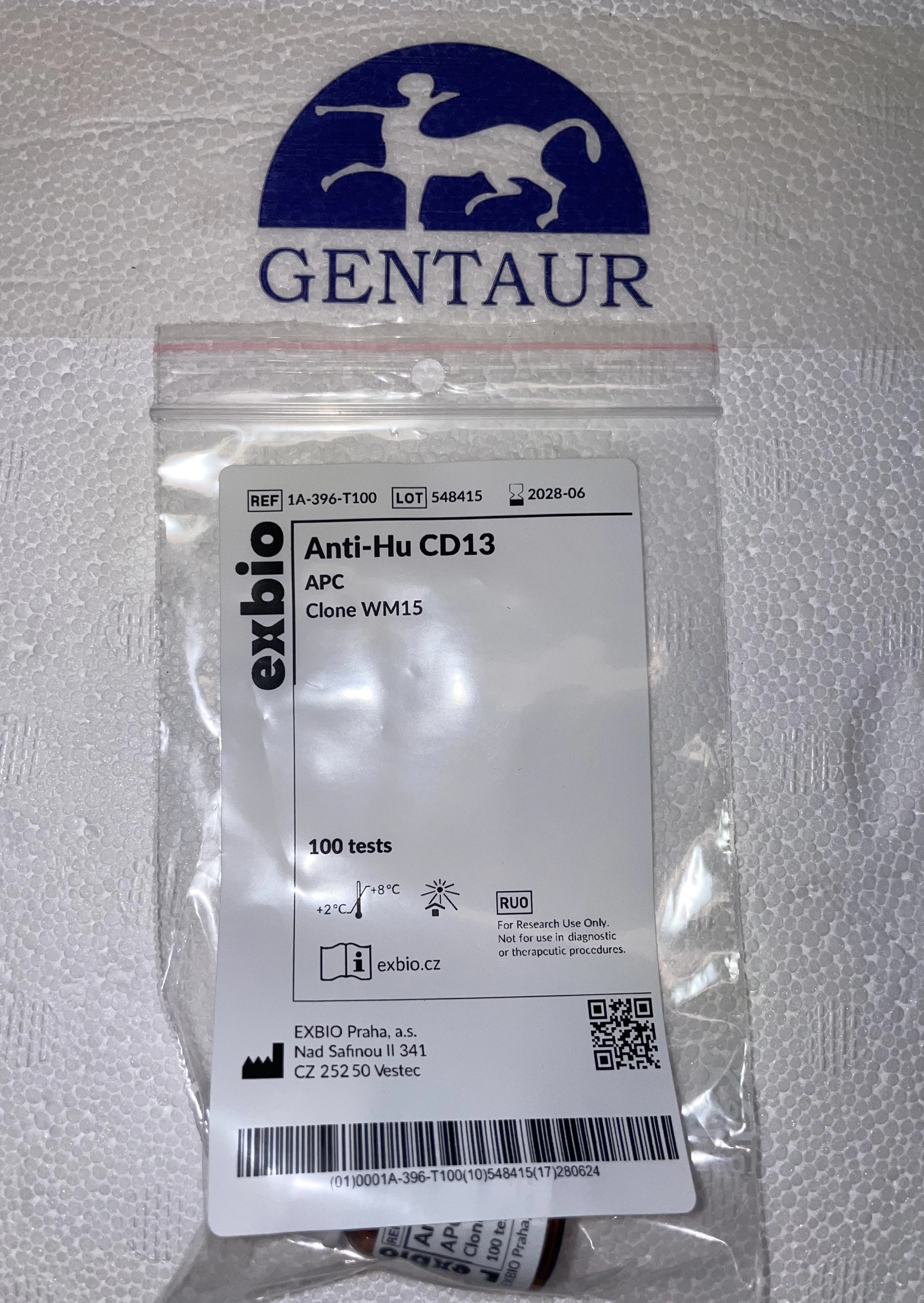
Anti-Hu CD13 APC
Catalog:0270-1A-396-T100
Available sizes
1 optionAvailability
Stock products usually ship within 24–48 hours. Non-stock products may require approximately 2–6 weeks.
Shipping conditions
No dry-ice requirement is indicated for this product.
Hazardous classification
This product is not currently marked as hazardous.
CD13 (aminopeptidase N, APN) is a 150 kDa type II transmembrane zinc-binding ectopeptidase expressed on various cell types. This metalloprotease preferentially catalyzes removal of neutral amino acids from small peptides, thus activating or inactivating bioactive peptides. CD13 has also role in extracellular matrix degradation, antigen processing and signal transduction, is important in inflammatory responses, regulates intercellular contact, cell motility and vascularization. CD13 is involved in protection of leukemic cells against apoptosis and its expression associated with poor prognosis of carcinomas.
This product is intended for laboratory and research use only. Review the supplied documentation before use.
Product Name
Anti-Hu CD13 APC
Catalog Number
0270-1A-396-T100
Available Sizes
100 Tests
Hazardous
No
Dry Ice
No
Certification
RUO
Applications
FC (QC tested)
Buffer
Stabilizing phosphate buffered saline (PBS), pH 7.4, 15 mM sodium azide
Clone
WM15
Format
APC
Immunogen
Human AML cells
Other References
*Tokuhara T, Hattori N, Ishida H, Hirai T, Higashiyama M, Kodama K, Miyake M. Clinical significance of aminopeptidase N in non-small cell lung cancer. Clin Cancer Res. 2006 Jul 1;12 (13) :3971-8., URL: https://pubmed.ncbi.nlm.nih.gov/16818694/, *Petrovic N, Schacke W, Gahagan JR, O'Conor CA, Winnicka B, Conway RE, Mina-Osorio P, Shapiro LH. CD13/APN regulates endothelial invasion and filopodia formation. Blood. 2007 Jul 1;110 (1) :142-50., URL: https://pubmed.ncbi.nlm.nih.gov/17363739/, *Terauchi M, Kajiyama H, Shibata K, Ino K, Nawa A, Mizutani S, Kikkawa F. Inhibition of APN/CD13 leads to suppressed progressive potential in ovarian carcinoma cells. BMC Cancer. 2007 Jul 27;7:140., URL: https://pubmed.ncbi.nlm.nih.gov/17655775/
References And Citations
*Favaloro EJ, Browning T, Facey D: CD13 (GP150; aminopeptidase-N) : predominant functional activity in blood is localized to plasma and is not cell-surface associated. Exp Hematol. 1993 Dec;21 (13) :1695-701. , URL: https://www.ncbi.nlm.nih.gov/pubmed/7902291?dopt=A, *McCormack E, Mujic M, Osdal T, Bruserud O, Gjertsen BT: Multiplexed mAbs: a new strategy in preclinical time-domain imaging of acute myeloid leukemia. Blood. 2013 Feb 14;121 (7) :e34-42. doi: 10.1182/blood-2012-05-429555., URL: https://www.ncbi.nlm.nih.gov/pubmed/23243270, *Leukocyte Typing V., Schlossman S. et al. (Eds.), Oxford University Press (1995) ., URL: , *Leukocyte Typing IV., Knapp W. et al. (Eds.), Oxford University Press (1989) ., URL: , *Leukocyte Typing III., McMichael A.J. et al. (Eds.), Oxford University Press (1987) ., URL: , *Bradstock KF, Favaloro EJ, Kabral A, Kerr A, Hughes WG, Musgrove E: Myeloid progenitor surface antigen identified by monoclonal antibody. Br J Haematol. 1985 Sep;61 (1) :11-20., URL: https://www.ncbi.nlm.nih.gov/pubmed/4052321?dopt=A, *Bradstock KF, Favaloro EJ, Kabral A, Kerr A, Hughes WG, Berndt MC, Musgrove E: Human myeloid differentiation antigens identified by monoclonal antibodies: expression on leukemic cells. Pathology. 1985 Jul;17 (3) :392-9. , URL: https://www.ncbi.nlm.nih.gov/pubmed/3865147?dopt=A, *Weijler L, Kowarsch F, Wödlinger M, Reiter M, Maurer-Granofszky M, Schumich A, Dworzak MN: UMAP based anomaly detection for minimal residual disease quantification within acute myeloid leukemia. Cancers (Basel) 2022 Feb 11;14 (4) :898., URL: https://pubmed.ncbi.nlm.nih.gov/35205645/
Storage Conditions
Store at 2-8°C. Protect from prolonged exposure to light. Do not freeze.
Target Antigen
CD13
Isotype
Mouse IgG1
Specificity
The antibody WM15 recognises an extracellular epitope of human CD13 cell surface glycoprotein, a 150 kDa molecule expressed on granulocytes, endothelial cells, epithelial cells and myeloid progenitors.
Applications Notes
6
Reactivity
Human, Non-human primates